
⭐ Purpose of the SVQ Awards
1. Overall Purpose of SVQs in Social Services (CYP) and Social Services & Healthcare
Across both sectors—Children & Young People (CYP) and Adult Health & Social Care—SVQs are designed to:
- Demonstrate competence in job‑related skills within real workplace settings. [sqa.org.uk]
- Ensure practice aligns with the National Occupational Standards (NOS), which define the knowledge and skills required across the sector. [sqa.org.uk], [sqa.org.uk]
- Provide a nationally and internationally recognised qualification required for SSSC registration at practitioner or senior levels. [sqa.org.uk]
- Allow progression into higher responsibility roles, further SVQs, HNCs, and advanced Childhood Practice / Social Care qualifications. [sqa.org.uk], [sqa.org.uk]
- Minimise time away from work by using workplace assessment and portfolio evidence as the primary method of demonstrating competence. [sqa.org.uk], [sqa.org.uk]
⭐ Purpose by SCQF Level
SCQF Level 6 (SVQ 2)
Purpose
- Confirms competence for support worker / assistant roles that involve routine but responsible care tasks. [sqa.org.uk]
- Focuses on providing safe, person‑centred care and supporting individuals or children under supervision, aligned with NOS.
SCQF Level 7 (SVQ 3)
Purpose
- Demonstrates competence for the role of practitioner in early years, social care, residential care, education and family‑support roles. [sqa.org.uk]
- Shows the learner can:
- Work autonomously and make decisions.
- Carry out complex, non‑routine tasks.
- Safeguard and promote wellbeing.
- Reflect on practice and support others. [glasgowclyde.ac.uk]
- Required by the SSSC for practitioner registration in early years and social services settings. [sqa.org.uk]
SCQF Level 9 (SVQ 4)
Purpose
- Designed for senior practitioners, supervisors, managers or those with significant responsibility. [sqa.org.uk]
- Demonstrates ability to:
- Lead practice and ensure quality.
- Manage teams, complex situations, or service delivery.
- Apply high‑level professional judgement.
- Oversee safeguarding, service planning and risk management.
- Required for SSSC registration in lead practitioner / management roles.
⭐ Prior Knowledge & Entry Expectations by Level
SVQs do not always demand formal academic prerequisites, but learners must be in appropriate job roles that allow them to generate evidence. The expectations below reflect official guidance.
SCQF Level 6 (SVQ 2): Prior Knowledge Requirements
- Must be working (or in placement) in a support worker role involving routine care tasks. [sqa.org.uk]
- No formal qualifications required, but expected to have:
- Basic understanding of care values, safeguarding, communication.
- Ability to follow guidance and work under supervision.
- Some centres require PVG membership (varies by employer policies).
SCQF Level 7 (SVQ 3): Prior Knowledge Requirements
- Must be employed in a post with complex, non‑routine tasks, and with autonomy appropriate to a practitioner. [glasgowclyde.ac.uk]
- Should have:
- Experience in social care or early years settings.
- Prior learning from practice or qualifications such as HNC Childhood Practice / Social Care can contribute underpinning knowledge. [sqa.org.uk]
- SSSC requirement: Practitioners must be working toward or already hold this qualification. [sqa.org.uk]
SCQF Level 9 (SVQ 4): Prior Knowledge Requirements
- Must already hold (or be working at the level of) a senior role with responsibility for:
- Leadership
- Supervision
- Service planning or oversight
- High‑level safeguarding decisions [sqa.org.uk]
- Prior qualifications contributing knowledge may include:
- HNC/D Social Care,
- Other SCQF Level 7–8 qualifications. [sqa.org.uk]
- Must be able to gather evidence of high‑level decision‑making and leadership.
⭐ Summary Table
| SCQF Level | Award | Purpose | Prior Knowledge / Role Requirement |
| Level 6 (SVQ 2) | Social Services (CYP) / Social Services & Healthcare | Competence in support roles; routine care tasks; foundation practice | Working in assistant/support role; basic care knowledge; supervision expected [sqa.org.uk] |
| Level 7 (SVQ 3) | Social Services (CYP) / Social Services & Healthcare | Practitioner-level competence; autonomy; complex tasks; safeguarding; reflective practice | Must be in practitioner job role with autonomy; experience preferred; HNC may support knowledge; SSSC requires working toward this award [sqa.org.uk], [glasgowclyde.ac.uk] |
| Level 9 (SVQ 4) | Social Services (CYP) / Social Services & Healthcare | Senior practice; leadership; managing teams and complex decisions; service quality | Must hold senior/lead role; high responsibility; prior SCQF 7–8 qualifications useful; requires evidence of leadership practice [sqa.org.uk] |
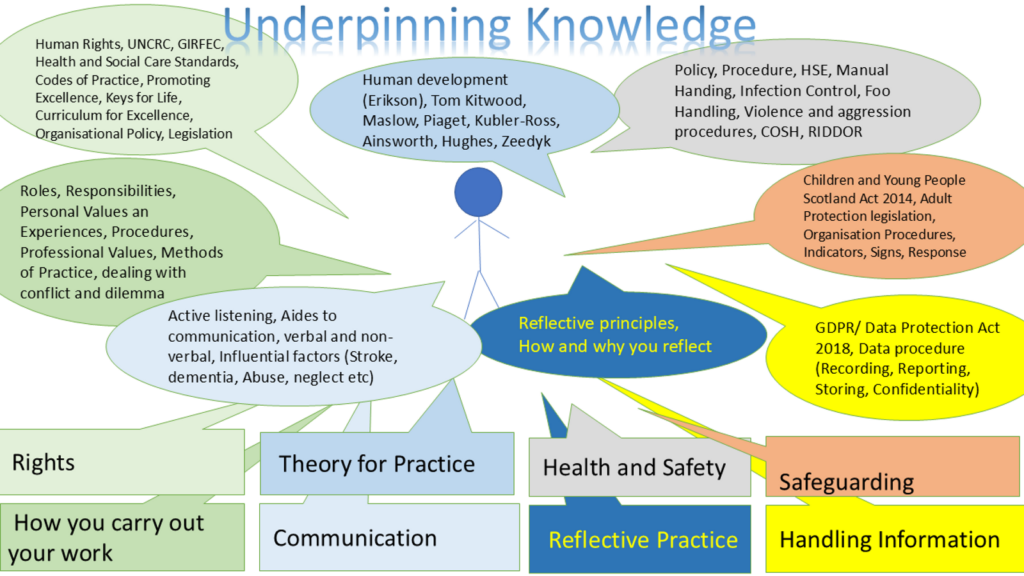
As the SVQ qualifications are not training courses. Learners need to prepare themselves for SVQ assessment by acquiring the underpinning knowledge that supports their practice before they apply for the Awards.
This includes relevant theory, Legislation, Policy and Procedure. Consideration must be given to specific legislation that are region specific. Learners must be able to show and understanding of relevant Scottish Legislation as well as UK legislation.
You will find below examples of key areas within SVQ Awards. The level of knowedge will be determined by the specific SCQF level:
SCQF Levels explained
⭐ Overview
SVQs are mapped to the Scottish Credit and Qualifications Framework (SCQF). The SCQF level indicates the complexity, autonomy, judgement, and responsibility expected of candidates.
- SVQ 2 → SCQF Level 6
- SVQ 3 → SCQF Level 7
- SVQ 4 → SCQF Level 9
[sqa.org.uk]
The higher the SCQF level, the higher the expectation for independence, critical thinking, problem‑solving, and professional responsibility.
⭐ SVQ 2 (SCQF Level 6) — Support Worker Level
Expectations at SVQ 2
At SCQF Level 6, candidates are expected to:
- Carry out routine, predictable tasks under guidance.
- Show competence in delivering direct care and support, following organisational procedures.
- Demonstrate knowledge of basic care principles, health and safety, and safeguarding.
- Rely on supervisors for direction and decision‑making.
[sqa.org.uk]
What SCQF Level 6 Represents
SCQF Level 6 reflects the ability to:
- Apply knowledge in familiar contexts.
- Use straightforward problem‑solving.
- Take some responsibility, but decisions are largely guided by others. [sqa.org.uk]
Role Fit
Typical roles include:
- Support Worker
- Assistant in social care or early years settings
These roles involve carrying out tasks rather than planning or leading practice.
⭐ SVQ 3 (SCQF Level 7) — Practitioner Level
Expectations at SVQ 3
At SCQF Level 7, candidates must:
- Undertake complex, non‑routine tasks with considerable autonomy.
- Make independent decisions in line with organisational and professional standards.
[glasgowclyde.ac.uk] - Apply deeper knowledge of child development, safeguarding, reflective practice and planning.
- Provide explanations and justifications for actions.
- Use reflective processes to continually improve practice.
[cityandguilds.com]
What SCQF Level 7 Represents
SCQF Level 7 indicates ability to:
- Use analytical and evaluative skills.
- Apply detailed knowledge in a range of contexts.
- Take increased responsibility and manage parts of the work of others.
- Work autonomously and adapt practice as circumstances change.
[glasgowclyde.ac.uk]
Role Fit
Typical roles:
- Early Years Practitioner
- Residential Childcare Worker
- Day Centre Practitioner
These roles require independent judgement, safeguarding responsibilities and reflective practice.
⭐ SVQ 4 (SCQF Level 9) — Senior Practitioner / Managerial Level
Expectations at SVQ 4
At SCQF Level 9, candidates must:
- Demonstrate high‑level professional judgement, decision‑making and leadership.
- Manage complex situations, including risk, safeguarding, staff supervision and quality assurance.
- Apply specialised knowledge across varied and unpredictable contexts.
- Take full responsibility for service delivery, guidance of others and ensuring standards are met.
[sqa.org.uk]
What SCQF Level 9 Represents
SCQF Level 9 signifies:
- Critical understanding of theories and professional principles.
- Application of knowledge in unpredictable settings.
- Responsibility for managing people, resources and service outcomes.
- Ability to evaluate, influence and improve practice at a strategic level. [sqa.org.uk]
Role Fit
Typical roles include:
- Senior Practitioner
- Team Leader
- Manager / Supervisor in social care or early years settings
These roles require leadership, performance monitoring and an advanced understanding of legislation and organisational requirements.
⭐ Comparison Table
| Award | SCQF Level | Complexity | Autonomy | Decision‑Making | Typical Role |
|---|---|---|---|---|---|
| SVQ 2 | 6 | Routine tasks | Works under guidance | Follows procedures | Support Worker |
| SVQ 3 | 7 | Complex, non‑routine | Works autonomously | Makes independent decisions | Practitioner |
| SVQ 4 | 9 | Highly complex, varied | Leads others | High‑level professional judgement | Senior Practitioner / Manager |
Evidence: [sqa.org.uk], [glasgowclyde.ac.uk], [sqa.org.uk]
⭐ Summary
Understanding the SCQF levels helps to clarify expectations:
- SVQ 2 (SCQF 6): Competence in routine care with supervision.
- SVQ 3 (SCQF 7): Competence in autonomous practitioner-level work, decision-making, and reflective practice.
- SVQ 4 (SCQF 9): Competence in leadership, management, and high-level professional judgement.