
Building Upon Noel Burch's Four Stages of Competence
The way people learn and develop professionally has fascinated educators, psychologists, leaders, and practitioners for decades.
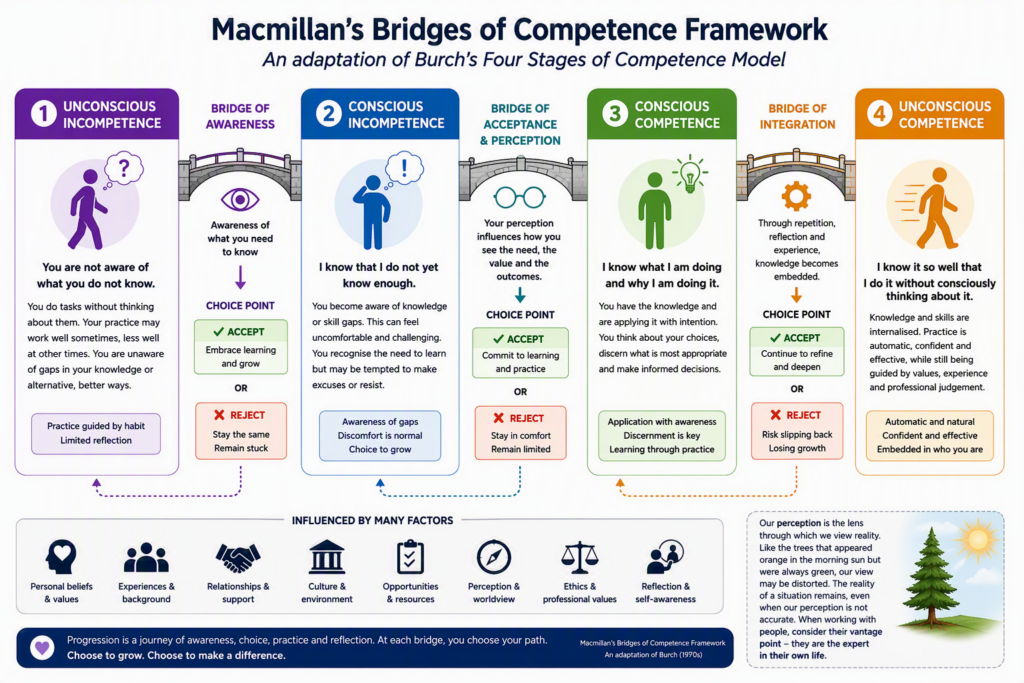
One of the most influential contributions to our understanding of learning was made by Noel Burch, who, during the 1970s, developed the Four Stages of Competence Model. Burch proposed that people progress through four stages as they develop knowledge and skills:
- Unconscious Incompetence
- Conscious Incompetence
- Conscious Competence
- Unconscious Competence
His model continues to be widely used in education, leadership development, coaching, and workforce training because it provides a simple and effective way of understanding how people learn.
However, during conversations with colleagues about why experienced people often feel deskilled when entering a new role, starting a qualification, or facing unfamiliar challenges, I began to ask a different question:
What actually happens between the stages?
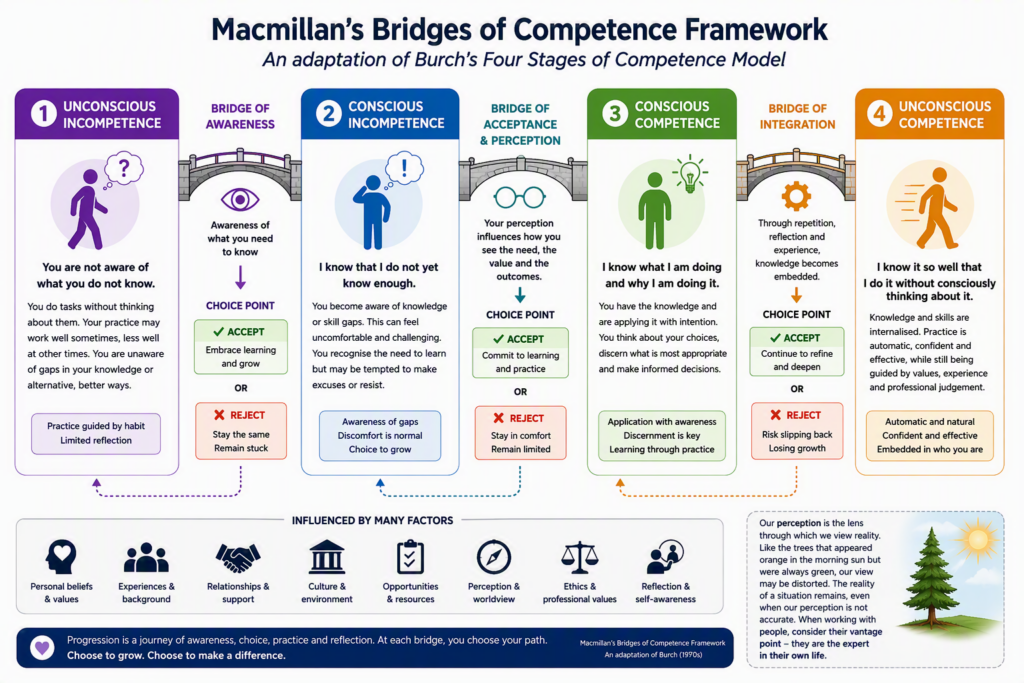
This question led to the development of Macmillan's Bridges of Competence Framework, an adaptation of Burch's model that explores the psychological and environmental factors that influence progression, including awareness, perception, mindset, reflection, relationships, and professional judgement.
Rather than viewing competence development as a simple linear process, the framework explores the bridges that people must cross before learning becomes embedded in practice.
The Framework
The foundation remains Burch's original model. What has been added is an exploration of the transitional spaces between the stages, where choices are made and development either progresses or stalls.
The framework proposes three developmental bridges:
- The Bridge of Awareness
- The Bridge of Acceptance and Perception
- The Bridge of Integration
Each bridge contains decision points, opportunities for reflection, and influences that shape the individual's learning journey.
Stage One: Unconscious Incompetence
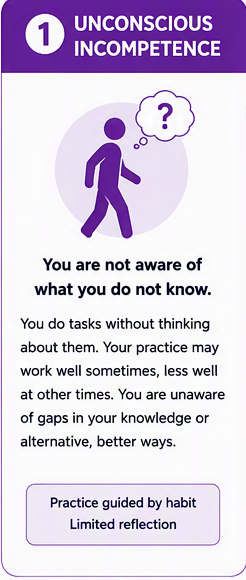
At this stage, individuals are unaware of gaps in their knowledge, understanding, or skills.
They perform tasks based on habit, previous experience, or established routines. In many cases, these approaches may be effective. However, there may also be opportunities for improvement that remain unseen because awareness has not yet developed.
A simple description of this stage is:
"You do not know what you do not know."
Most of us begin here.
Before undertaking a qualification, receiving additional training, or experiencing a significant challenge, we often assume our current understanding is sufficient. While our practice may be adequate, we may lack awareness of alternative perspectives, evidence-based approaches, or new developments in our field.
The challenge is not a lack of ability.
The challenge is a lack of awareness.
The First Bridge: Awareness
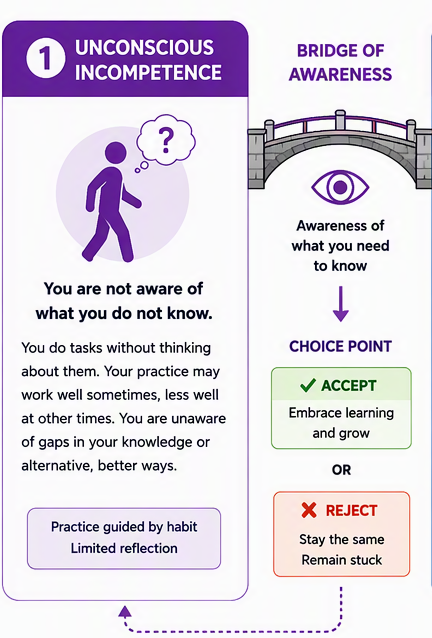
The first bridge is crossed when awareness is introduced.
Awareness may emerge through:
- Education and training
- Supervision
- Mentoring
- Reflection
- Feedback
- Research
- Personal experience
- Observation of others
In today's world, information is abundant. The challenge is rarely finding information. The challenge is recognising that information exists which could improve our understanding or practice.
Once awareness develops, a choice appears.
Do we explore what we have discovered, or do we remain where we are?
This transition is not simply about knowledge. It is about curiosity.
Stage Two: Conscious Incompetence
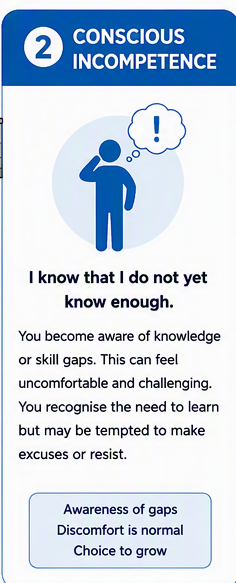
This is often the most uncomfortable stage.
Here we become aware of what we do not know.
Many learners describe this as feeling deskilled. Knowledge gaps become visible, assumptions are challenged, and confidence may temporarily fall as we recognise there is more to learn than we initially realised.
A practical way to describe this stage is:
"I know that I do not yet know enough."
While uncomfortable, this stage is one of the most important stages of professional development.
Growth begins when certainty is replaced with curiosity.
Importantly, progression during this stage is heavily influenced by psychological safety.
People are more willing to admit uncertainty, ask questions, seek support, and experiment with new ideas when they feel safe to learn without fear of criticism or embarrassment.
The Second Bridge: Acceptance, Perception and Interpretation
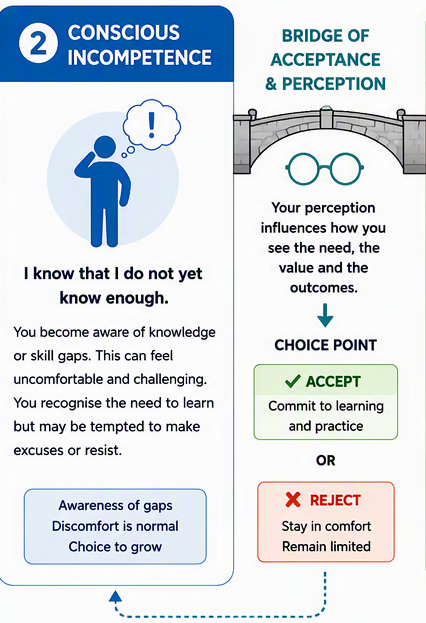
The second bridge explores how people respond to new knowledge.
Traditionally, we may think about accepting or rejecting new ideas. However, modern learning is rarely that simple.
When encountering new information we may:
- Accept it
- Question it
- Test it
- Adapt it
- Integrate it
- Reject it
This process is influenced by perception.
Every person views situations through a unique lens created by:
- Experiences
- Values
- Culture
- Beliefs
- Relationships
- Professional identity
- Emotional state
- Organisational culture
These factors shape how we interpret information and determine what we believe to be true.
The Evergreen Tree Analogy
One morning I noticed fir trees appearing bright orange in the early sunlight.
For a moment I wondered whether the winter weather had affected them.
The reality, however, had not changed.
The trees remained green.
It was my perception that had changed, not the trees themselves.
This experience reinforced an important insight:
Perception influences understanding, but perception does not determine reality.
In professional practice this is particularly important.
The people we support experience their lives differently from us.
We bring our knowledge and experience to the situation, but they remain the experts in their own lives.
Understanding another person's perspective often provides the bridge towards better decisions and better outcomes.
Stage Three: Conscious Competence
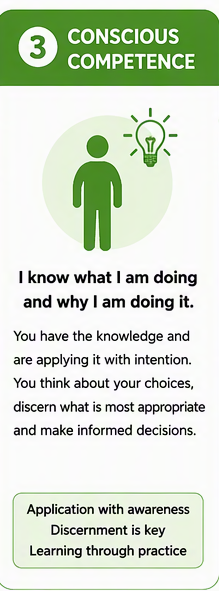
At this stage knowledge begins to influence behaviour intentionally.
The learner not only understands a concept but begins applying it consciously in real situations.
This is often accompanied by moments of insight:
"I understand what I am doing."
and
"I understand why I am doing it."
The defining feature of this stage is discernment.
Modern professionals are exposed to countless models, theories, methods, technologies, and sources of information.
Competence is not demonstrated by knowing everything.
Competence is demonstrated by selecting the most appropriate response for the person, situation, or problem in front of you.
Knowledge becomes useful when applied thoughtfully.
Growth Mindset and Reflective Intelligence
The willingness to cross bridges is influenced significantly by mindset.
Individuals with a growth mindset recognise that:
- Learning is continuous.
- Expertise is never complete.
- Mistakes are opportunities for learning.
- Feedback is valuable.
- Alternative perspectives strengthen understanding.
Alongside mindset sits what I describe as reflective intelligence.
Reflective intelligence is the ability to examine our assumptions, question our decisions, and learn deliberately from experience.
In an age where information is readily available, reflective intelligence may be more valuable than knowledge alone.
The Third Bridge: Integration
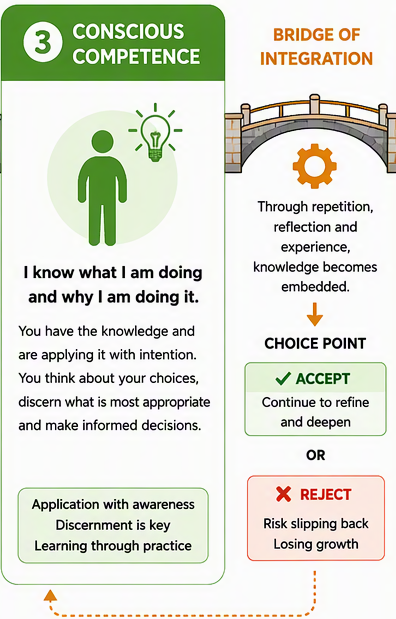
Knowledge does not become expertise overnight.
The final bridge involves integration.
Integration occurs through:
- Repetition
- Experience
- Reflection
- Supervision
- Discussion
- Feedback
- Continuous learning
Every decision provides information.
Every outcome teaches something.
Over time knowledge becomes less deliberate and more natural because it has been tested repeatedly in practice.
Stage Four: Unconscious Competence
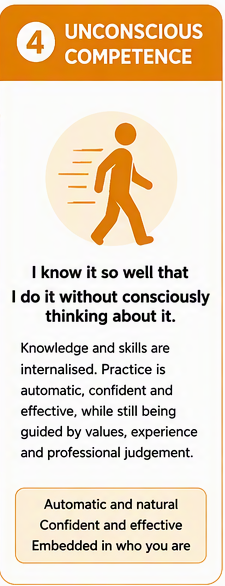
Eventually knowledge becomes embedded.
Skills become instinctive.
Decision-making becomes more fluid.
Practice becomes more natural.
This is the stage that Burch described as Unconscious Competence.
"I know it so well that I do it without consciously thinking about it."
However, expertise should never be confused with knowing everything.
Contemporary practice requires humility.
The most effective practitioners remain curious, continue learning, and remain willing to re-enter earlier stages when circumstances, research, legislation, technology, or people's needs change.
True expertise combines confidence with openness.
Competence Is Not a Destination
One limitation of many competence models is the suggestion that learning ends when expertise is achieved.
Real life is rarely that straightforward.
An experienced practitioner may be unconsciously competent in one area whilst simultaneously experiencing conscious or unconscious incompetence in another.
Technology evolves.
Research advances.
Legislation changes.
People's needs change.
Society changes.
Competence development is therefore not a straight line but an ongoing cycle of awareness, adaptation, reflection, and growth.
The Central Principle: Every Bridge Contains a Choice
The most significant contribution of Macmillan's Bridges of Competence Framework is the recognition that progression is not automatic.
At every bridge we encounter choices.
We can:
- Explore or ignore.
- Reflect or avoid reflection.
- Adapt or resist change.
- Learn or remain comfortable.
- Challenge assumptions or defend them.
Our decisions are influenced by relationships, values, organisational culture, psychological safety, lived experience, motivation, confidence, and perception.
Competence is therefore far more than the acquisition of knowledge.
It is the ongoing process of developing awareness, applying judgement, reflecting critically, adapting to change, and integrating learning into practice.
Ultimately, the question is not:
"What do I know?"
The more important question is:
"What will I do when I discover what I do not know?"
Acknowledgement
Macmillan's Bridges of Competence Framework is an adaptation of Noel Burch's Four Stages of Competence Model. The framework builds upon Burch's original work by exploring the role of awareness, perception, mindset, psychological safety, reflection, interpretation, acceptance, and integration in the journey from learning to expertise.